
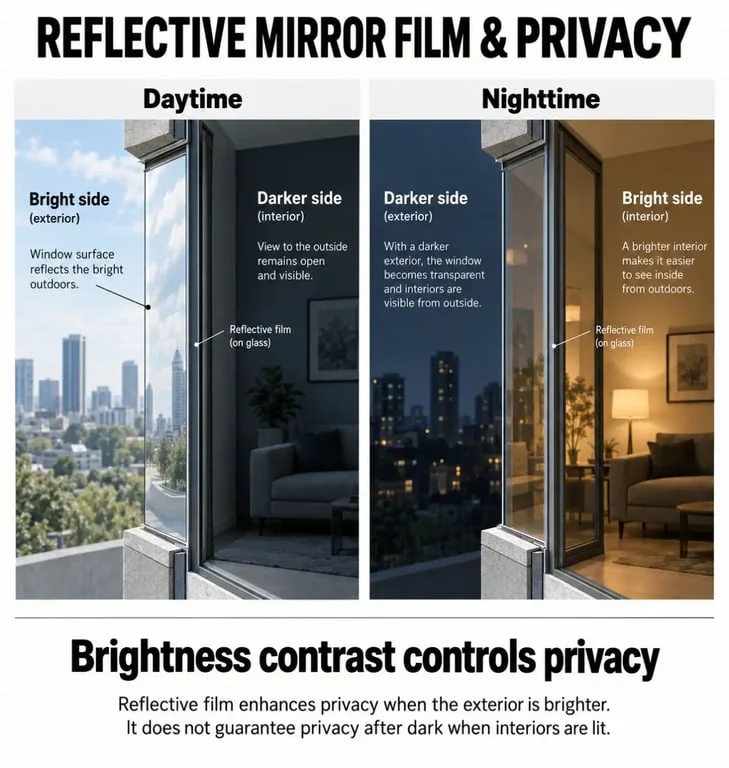
Reflective mirror film can make a street-facing window feel much less exposed while preserving a usable view outdoors during daylight. It can also reduce glare, strong sunlight, and solar heat in rooms that overheat easily. The key limitation is straightforward: the mirror effect depends on the difference in brightness between both sides of the glass, so the film is not a replacement for curtains or blinds after dark.
What reflective mirror film actually does
Reflective mirror film is a thin window covering applied to the interior face of flat glass. From the brighter side, it creates a mirrored appearance. From the darker side, the view remains more open. Retailers may also describe it as mirrored window film, one-way window film, or reflective window tint.
The surface reflects part of the incoming solar energy and visible light. This can reduce screen glare, limit solar heat entering the room, and slow fading caused by sunlight on textiles, furniture, walls, and window treatments. UV rejection varies by product, so check the manufacturer’s specification instead of assuming that every silver film offers the same level of protection.
The light contrast is the whole mechanism
Privacy comes from the contrast between the two sides of the glass. During the day, the outdoors is usually brighter than the room. People outside see the reflective surface, while you can generally see out. At night, a lit interior can become brighter than the exterior. The visual balance reverses, and the room may then be visible from outside.
Think of the window as a layered boundary rather than a permanently one-way screen. Exterior daylight, the reflective coating, the glass, and indoor lighting all affect the result. A porch light, a lamp close to the window, or a dark winter afternoon can change privacy more than the film’s color alone.
Where it works well and where it needs backup
Reflective mirror film is useful on ground-floor living-room windows, home offices, glazed doors, office partitions, and retail-facing glass where daytime overlooking is the main concern. It can also give the exterior a cleaner appearance while reducing harsh reflections on televisions and monitors.
Daytime privacy versus nighttime privacy
If you need privacy around the clock, plan a second layer, such as blinds, curtains, shutters, or another privacy film. Frosted and blackout films provide a different level of visual screening, although they affect the view and daylight in their own ways.
Dual-reflective film can reduce the mirror-like appearance on the interior side and may improve outward visibility in lower light. It does not change the basic rule of brightness, however. No standard reflective film should be chosen on the promise of guaranteed nighttime privacy.
Glass and room suitability
Use film only on surfaces approved by the product manufacturer. Flat interior glass is the usual application surface. Before buying for double-pane or insulated glass units, check compatibility carefully. Changing how the glass absorbs and releases solar heat can create thermal-stress concerns in some situations.
Consider the room as well. A highly reflective finish may suit a sunny office, but feel too dark or too commercial on a small north-facing kitchen window. The right choice depends on the room’s light, the desired appearance, and the times when privacy matters most.
Choose the film construction before choosing the shade
The darkest or shiniest film is not automatically the best buy. Strong reflectiveness may improve daytime privacy and heat control, but it can also reduce visible light and alter the quality of the outdoor view. Compare the product’s Visible Light Transmission (VLT), solar-performance data such as Total Solar Energy Rejected (TSER), and its recommended glass types when those details are available.
| Film type | Best for | Main trade-off |
|---|---|---|
| Reflective adhesive film | Long-term daytime privacy and solar control | Needs careful installation and is less easy to remove |
| Dual-reflective film | Reducing interior reflectivity while retaining solar control | Does not create full nighttime privacy |
| Static-cling reflective film | Rentals, temporary projects, and repositionable use | May not offer the permanence of adhesive products |
| Frosted film | Consistent privacy for bathrooms and partitions | Removes the clear outward view |
| Blackout film | Blocking light and visibility completely | Eliminates daylight and the view |
For a renter, static-cling film is often the lower-risk option because it can be removed or repositioned. For a large south- or west-facing window, an adhesive solar-control film may be the more durable choice. If reducing cooling costs is your goal, treat that as a possible benefit rather than a guaranteed saving. Window size, orientation, climate, shading, insulation, and air-conditioning habits all affect the result.
Install reflective window film without creating permanent flaws
Most DIY films use wet installation. The process is manageable, but the finish is unforgiving. Dust, creases, fingerprints, and scratches can remain visible once the film is in place. Work slowly in a clean, still room and avoid folding the material.
- Measure the visible glass area and cut the film slightly larger than the pane.
- Clean the glass thoroughly, including the edges and corners, then remove all lint.
- Spray the glass with the recommended application solution or a suitable soap-and-water mixture.
- Remove the release liner, wet the adhesive side if instructed, and place the film on the glass.
- Use a squeegee from the center outward to push solution and air toward the edges.
- Trim the edges neatly, then make a final pass with the squeegee.
Small moisture pockets can be part of the curing process, but trapped dirt or a sharply creased section will not improve with time. For expensive glass, awkward upper-floor windows, or large panels, a professional installer is a sensible precaution. Careful surface preparation matters more than speed.
Maintenance, removal, and the checks to make before ordering
Allow the film to cure before cleaning it. A 30-day wait is commonly recommended. After that, use a soft cloth or synthetic sponge with a non-abrasive cleaner. Avoid abrasive pads, blades, and harsh scrubbing at the edges, where lifting can begin.
Before placing an order, confirm the glass dimensions, whether the film is adhesive or static cling, the side of the glass where it must be applied, its VLT and reflectivity, and its compatibility with your glazing. Check the manufacturer warranty as well as any building, landlord, or homeowners association rules that may affect an exterior mirrored appearance.
These checks prevent a common disappointment: buying a film that looks excellent in a product photo but does not suit the room’s light, glass, or privacy schedule. If the film will be removed later, verify the removal conditions before choosing an adhesive product. A temporary project and a long-term installation do not call for the same construction.
{“@type”:”Article”,”@context”:”https://schema.org”,”headline”:”Reflective Mirror Film: Daytime Privacy, Solar Control, and the Nighttime Limit”,”inLanguage”:”en-US”,”description”:”Reflective mirror film can make a street-facing window feel much less exposed while preserving a usable view outdoors during daylight. It can also reduce glare, strong sunlight,…”}
Related guides to continue
To build a stronger understanding of this topic, continue with these related guides from the same site. They cover nearby decisions, maintenance points and practical details that often influence the final result.