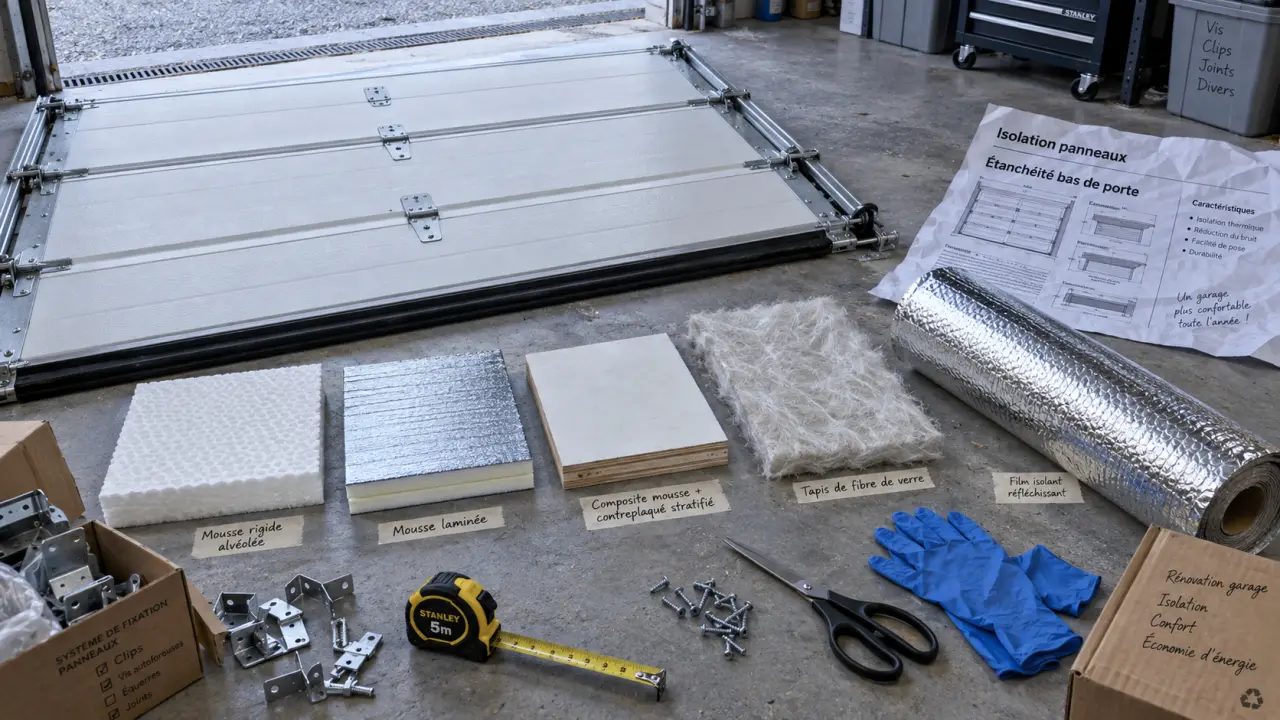
The best garage door insulation is not automatically the material with the highest R-value. A garage door moves several times a day, has narrow panel cavities, and relies on correctly balanced springs. For most homeowners, a lightweight foam-core or rigid-foam kit offers the best mix of thermal comfort, clean appearance, and straightforward DIY installation. Fiberglass can provide stronger thermal resistance, but it requires more care around moisture, weight, and long-term sagging.
Choose the insulation type that matches the way you use the garage
| Material | Best for | Main advantage | Main limitation |
|---|---|---|---|
| Rigid foam | DIY projects and storage garages | Lightweight, inexpensive, easy to cut | Usually lower thermal performance than fiberglass |
| Foam-core or laminate panels | Workshops and finished-looking garages | Neat finish, moderate insulation, low weight | Must fit the door-panel dimensions precisely |
| Fiberglass | Cold climates and heavily used workshops | High R-value potential and useful sound reduction | Can absorb moisture, sag, attract pests, and add weight |
| Reflective foil | Hot, sunny garages or low-effort upgrades | Thin, tidy, and simple to install | Works mainly as a radiant barrier, not as standalone bulk insulation |

For a comfortable workshop, prioritize foam panels
If you spend time repairing bikes, building furniture, or working at a bench, foam-core and polystyrene laminate panels are often the best garage door insulation choice. They sit neatly inside sectional door cavities, do not leave exposed fibers, and add little strain to the lifting system. Their moderate insulation level is usually enough to make the space feel less exposed to outdoor temperature swings, especially when the garage is attached to the house.
For harsh winter conditions, fiberglass needs a careful installation
Fiberglass is worth considering when the garage is regularly heated and you need the strongest practical thermal resistance. An R8 fiberglass kit is one option for this type of use. However, a garage door is not a static wall. Vibration, humidity, and repeated movement can make loose material slump over time. Choose a garage-door-specific kit with reliable retention clips or fasteners rather than forcing standard wall batts into the panels.
R-value matters, but air leaks can undermine the result
R-value measures resistance to conductive heat flow. It is a useful comparison point, but it does not describe the whole garage. A door with well-fitted, moderate-R-value panels can outperform a higher-rated installation that leaves gaps around the panel edges, bottom seal, or side weatherstripping. Insulation slows heat transfer; it does not create heat. A cold, unheated garage will still be cold, but outdoor temperature changes will affect it more slowly.
Reflective foil deserves particular caution. It is often presented as insulation, yet its main job is reflecting radiant heat. A double-bubble reflective foil product carries an R-value claim of 4, while its manufacturer claims 97 percent radiant heat reflection. Those figures may matter in a sun-exposed garage, but foil should not replace thicker insulation when winter heat retention is the priority.
Think of each door section as a thermal boundary rather than a single flat surface. The weakest point is often not the center of a panel but its joints, hinges, and perimeter, where moving parts make a perfect seal difficult. Before buying thicker panels, inspect the bottom weather seal and side stops. A small draft around the perimeter can make a carefully insulated door feel surprisingly ineffective.
Check door balance before adding weight
Weight is a practical limit that many buyers overlook. Springs and cables are sized to lift the existing door. Lightweight rigid foam and laminate boards normally have a modest effect, while fiberglass systems can add more load. After installation, disconnect the opener only if you understand the manufacturer’s safety procedure, then test whether the door stays roughly in place when raised halfway. A door that drops or shoots upward may need professional spring adjustment.
Measure panel cavities, rails, and obstructions first
Do not order a kit from the overall door width alone. Measure the usable width and height inside one panel cavity, then check the clearance around horizontal reinforcement rails, hinges, and the opener arm. Precut panels are convenient only when their dimensions match the door. For reference, some kits use eight panels measuring 4 feet by 2 feet, while Matador laminate panels measure 54 inches by 20.25 inches and are 1.25 inches thick.
Use attachment methods that survive repeated movement
Double-sided tape, adhesive squares, spray adhesive, and mechanical fasteners can all work, depending on the kit and door surface. Clean and dry the inside of every panel before fixing anything. Where appropriate, seal obvious stationary gaps with caulk or silicone first, but do not seal hinges, rollers, tracks, or moving joints. Adhesive that looks fine on day one can fail after hot weather or vibration, so check the panels after several opening cycles.
Match your purchase to the real problem, not the marketing claim
For a garage used mainly for parking and storage, a reflective-foam or rigid-foam kit is a practical upgrade. It keeps weight low, installs quickly, and gives the interior a cleaner surface than fiberglass. For a workshop where outdoor noise and winter cold are persistent issues, a foam-core panel system is usually the safer long-term choice. Its finished look also makes the room more pleasant to use.
Choose fiberglass only when you genuinely need higher thermal performance and can manage moisture protection and secure mounting. If the garage has leaks, a worn bottom seal, or an uninsulated ceiling below a bedroom, address those weaknesses too. In a 2-bay comparison with one uninsulated control door, the insulated side showed an 8 to 10 degree temperature difference after an hour. That is meaningful, but it also shows why the complete garage envelope, not the door alone, determines comfort.
Finally, treat extreme cooling claims with restraint. One premium reflective foam-core product claims a 30-degree reduction in hot summer weather, but actual results depend on direct sun, ventilation, wall insulation, and how often the garage is opened. Buy the kit that fits your panels securely, keeps the door balanced, and addresses your most immediate comfort problem.
{“@type”:”Article”,”@context”:”https://schema.org”,”headline”:”The Best Garage Door Insulation Depends on Weight, Fit, and How You Use the Space”,”inLanguage”:”en-US”,”description”:”The best garage door insulation is not automatically the material with the highest R-value. A garage door moves several times a day, has narrow panel cavities, and relies on…”}
Related guides to continue
To build a stronger understanding of this topic, continue with these related guides from the same site. They cover nearby decisions, maintenance points and practical details that often influence the final result.